
Handing students the chalk
An AI answer usually ends exactly where the student's thinking should begin. Chalk is a medium that lets a tutor build answers students work with, by predicting, testing, sorting and choosing where to go next. This is what learning research and our early testers taught us about designing them, and how we keep them cheap enough to be ordinary.
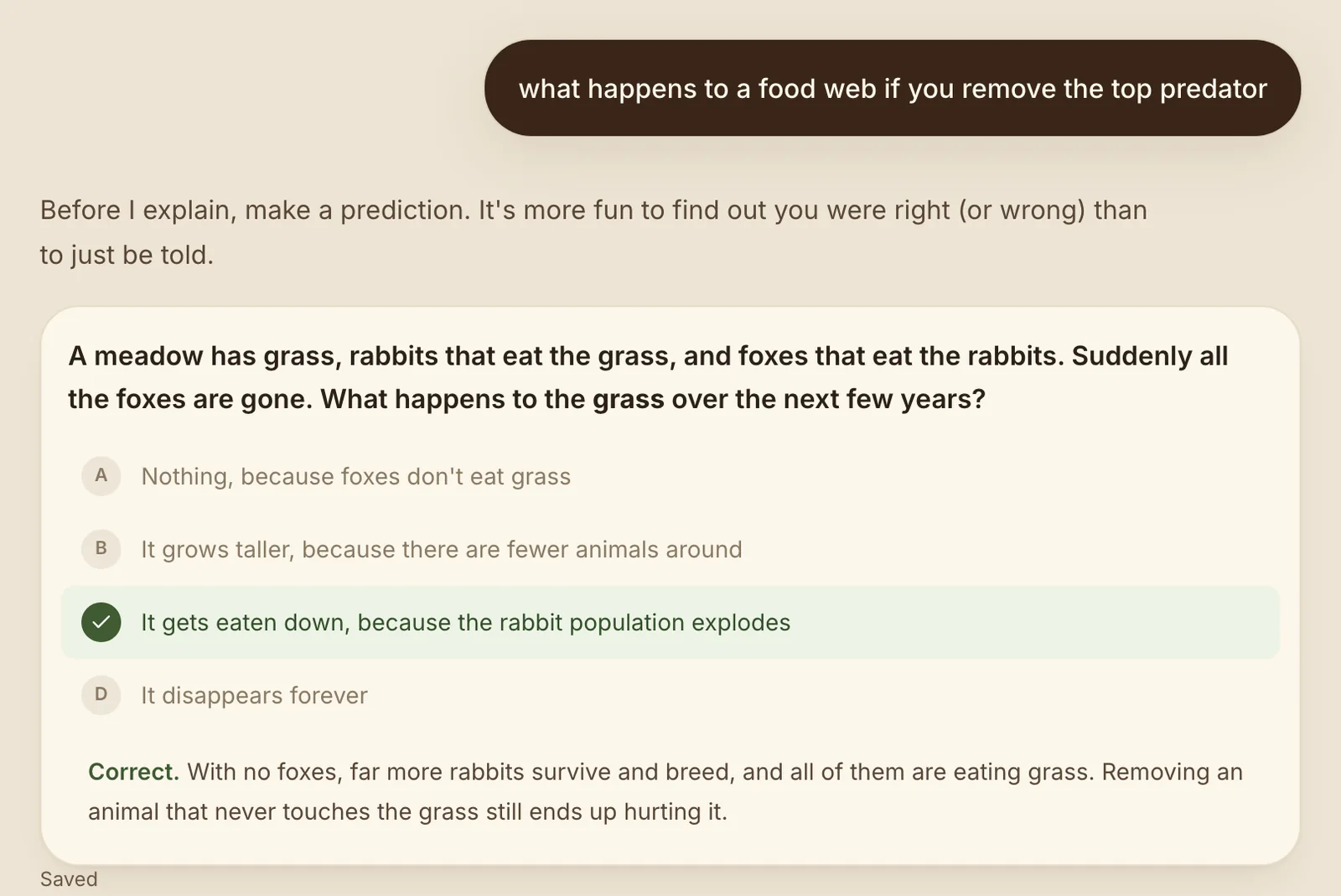
Ask a chatbot why removing foxes from a meadow would hurt the grass, and you will get a good answer. It will be clear, correct and complete, and it will arrive all at once. You read it, nod, and move on. Whether anything changed in your head along the way is mostly up to you.
The image above is a different answer to the same question, one our team wrote in Chalk as a reference for the tutor. Before explaining anything, the tutor asks the student to commit to a prediction. Only after they have answered does it name the idea they just reasoned their way into, a trophic cascade, and show where it happened in the real world.
That is a small change in form and a large change in who is doing the work. Chalk is our effort to make changes like it the normal shape of an AI answer. It is a medium in which the tutor can build things for the student to act on: steps that wait to be revealed, sliders that bend a graph, cards to sort, predictions to commit to, and paths to choose between. The model decides what to build. The student does the thinking.
We spent weeks with the learning research, turned what we found into interaction designs, and then tested those designs with a group of twelve to fourteen early users who tried them and told us what worked. Two findings shaped Chalk more than any others, and both are about giving the student something to do at the right moment.
Explanations that wait for you
The first is the simplest. A worked explanation normally arrives whole: every step, every connection, already laid out. It reads well. It also asks almost nothing of the reader at each transition, because the answer to “what comes next?” is always already on the screen.
Chalk can reveal an explanation one step at a time. The student reads a step, and the next one stays hidden until they ask for it.
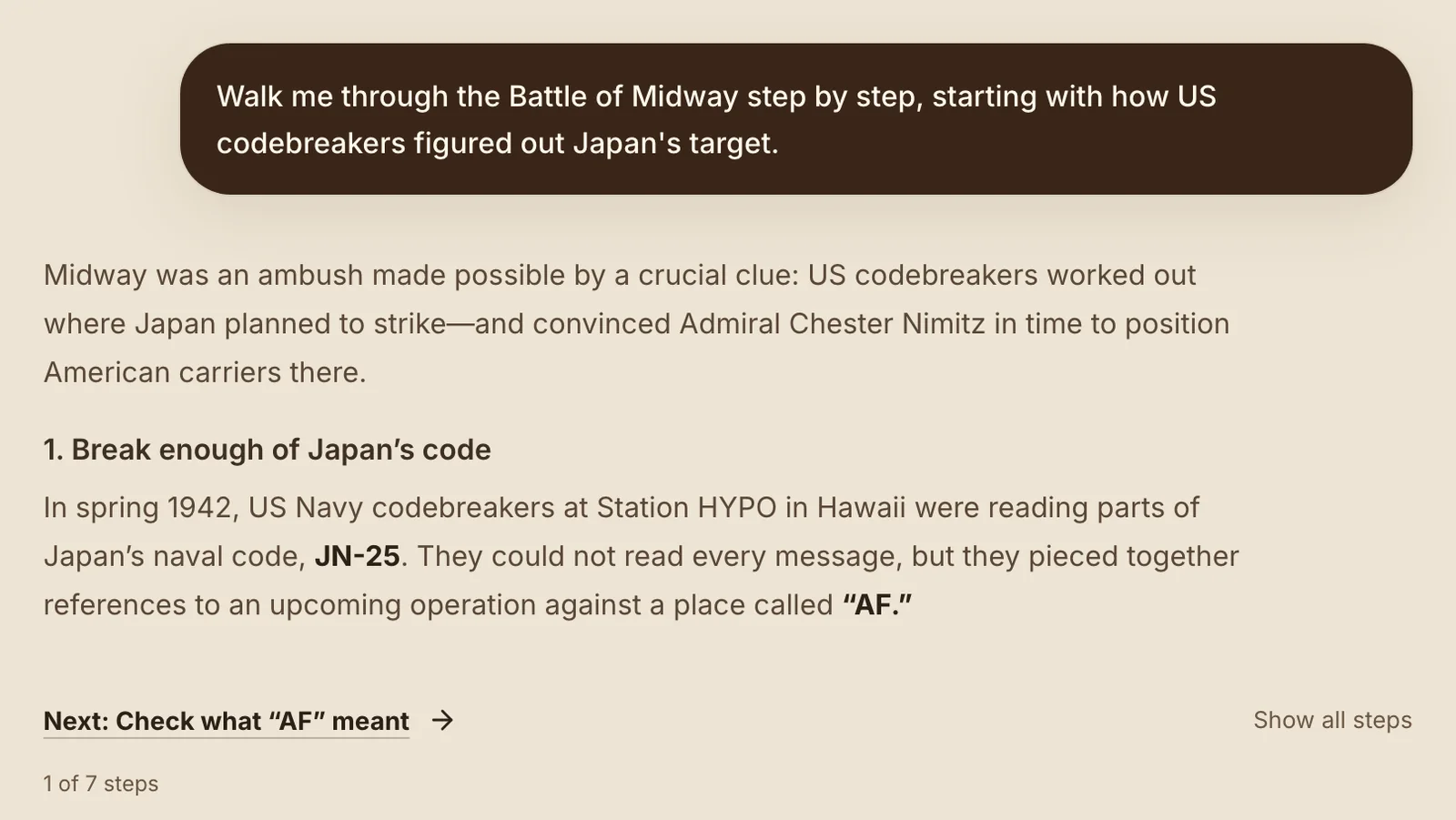
The student asks for the next step
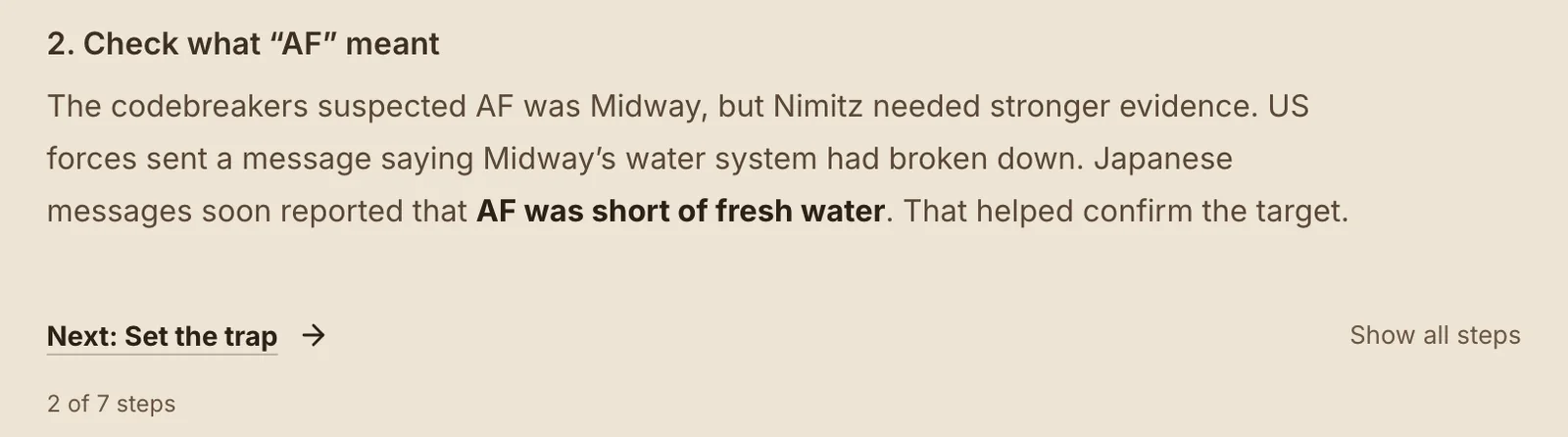
The pause after step one lands exactly where a student can ask the question the codebreakers faced: how would you prove that “AF” means Midway? Generated by the tutor.
In our testing, this changed how people read. The pause gave them a moment to anticipate the next step before seeing it, and to anticipate it they had to engage with the step in front of them. Repeating that across an explanation turned reading into a series of small predictions, each one checked a moment later.
That finding has deep roots. Chi and Wylie’s ICAP framework orders learning activities by what they ask of the learner, from passively receiving information, to manipulating it, to generating something new, to building it together in dialogue.1 Each step up tends to produce deeper learning. A reveal button is not magic on its own. But a pause placed where there is something worth predicting moves a student from receiving an explanation toward generating part of it.
Learner-paced segmenting has support of its own. In a multimedia study, students who could step through a narrated animation one segment at a time did better on problem-solving transfer than students who watched it run straight through.2
The placement is the craft. An arbitrary pause is friction. A good one lands on a consequence, a choice of approach, or a step whose logic becomes obvious once you have tried to supply it yourself. Deciding where those moments are is a teaching decision, and it is one the model has to make for every explanation it builds.
Predict before you are told
The food web answer goes one step further. It asks for the prediction before giving any explanation at all.
Psychologists have studied this for decades. Trying to retrieve something from memory makes it last longer than reading it again.3 More surprisingly, attempting an answer before you have been taught it, and getting it wrong, still improves how well you learn the right answer afterward.4 Manu Kapur calls the strongest version of this idea productive failure, and has made it a design for whole lessons: students try to solve a problem before they are taught the concept it needs, and instruction comes after.5 A meta-analysis of 53 studies found a moderate advantage for solving first and being taught second over the usual order, and a larger one when lessons followed productive-failure principles closely. The same analysis found the advantage reversed for second to fifth graders.6 For young children, then, the evidence is mixed, though some studies in that range find the benefit. In a randomized study of 159 second-to-fourth graders, those who explored unfamiliar math problems before being taught, with feedback along the way, understood the concepts better afterward than those who were taught first. The gain was conceptual, not procedural.7 The failed attempt prepares the ground. It makes the explanation that follows an answer to a question the student is already holding.
Chalk’s designs use this everywhere. A study session on the causes of the First World War does not start with a summary. It starts with eight cards to sort into long-term causes and immediate triggers, and a line telling the student that getting some wrong is useful, because the wrong ones show what to review.
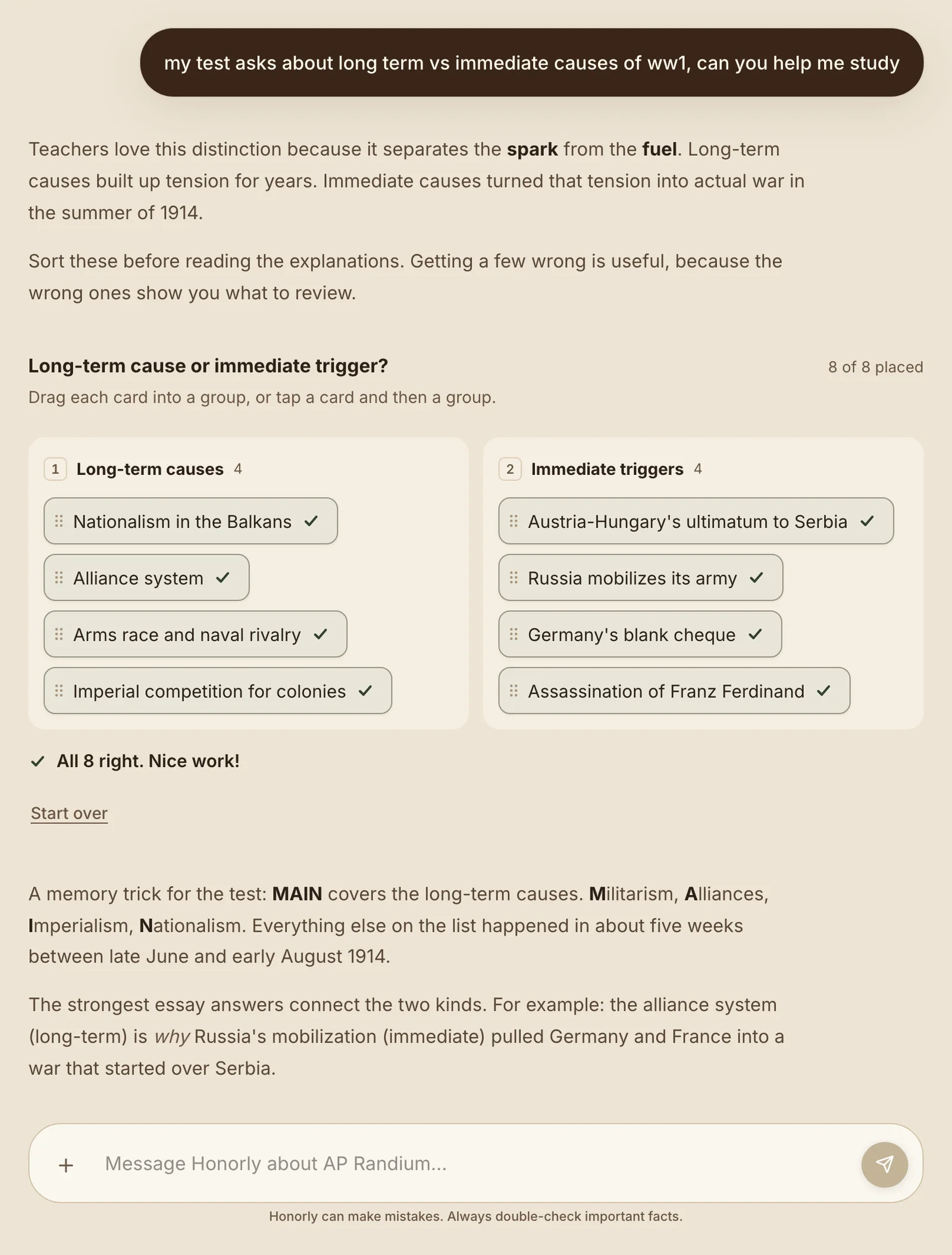
The student sorts first and reads second. The explanation that follows, including a mnemonic and a model of how strong essays connect the two kinds of cause, lands on someone who has just committed to an answer. A reference answer written by our team.
This is also where a lot of early ideas died. Some of our first designs were clever more than useful: features that were fun to see once and taught little. Testing with real users separated the interactions that made people think from the ones that only made the answer look busy.
Break it yourself
Research on what psychologists call seductive details explains why that distinction matters. Harp and Mayer found that adding interesting but irrelevant material to a science lesson made students learn less. Their experiments pointed to diversion more than simple distraction: the extra material led students to organize the lesson around the wrong prior knowledge.8 Entertainment that is not the subject competes with the subject.
So we hold Chalk’s interactions to a stricter standard than “is it engaging?” We ask what the student’s attention is on, what they can discover through the action, and whether the fun part and the learning part are the same part.
“What do a, h and k actually do?” Instead of a definition, the answer hands the student three sliders and tells them to break the parabola. Then it names the one that surprises everyone, h, which moves the graph right when the minus sign suggests left, and finishes with a challenge: build a parabola with its vertex at (2, −4) that passes through the origin. A reference answer written by our team.
Done well, the interaction is the explanation. The student who drags h and watches the vertex slide the “wrong” way has seen the idea before anyone states it. When the tutor then explains why, it is answering a question the student just asked themselves. Physics education research supports the general move: in a university circuits course, students who used a simulation in place of lab equipment did better on conceptual questions and at building a real circuit.9
The same principle lets Chalk meet students in their own work. A student who ran a pendulum lab and could not explain why mass did not matter gets back a chart of their own measurements, the formula, and a slider to check the formula’s prediction against what they timed. At one meter it predicts 2.01 seconds. They measured 2.0.
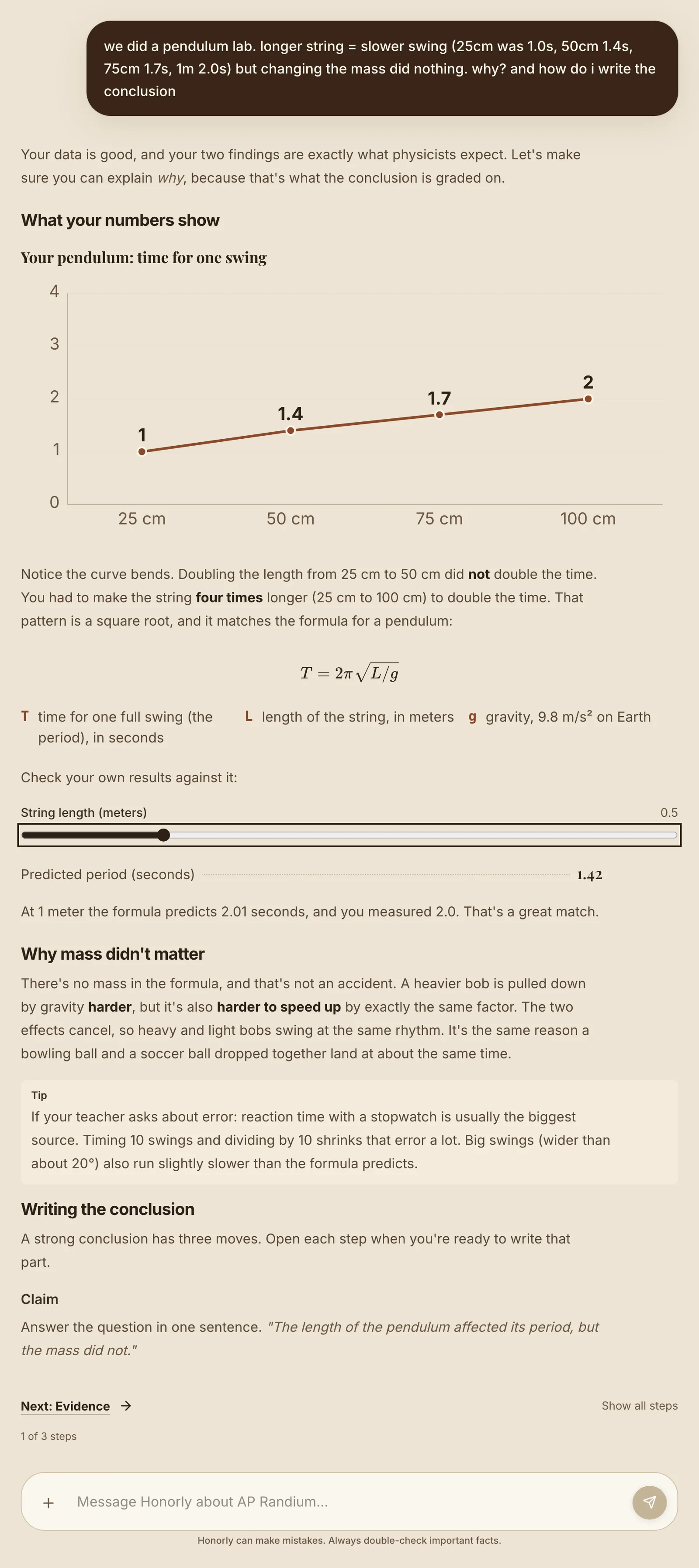
The student’s own data, the physics that explains it, and a structured path to writing the conclusion, revealed one move at a time so the student writes each part themselves. A reference answer written by our team.
Give curiosity somewhere to go
The second major finding was about the end of an answer. A student can be genuinely interested in an idea without knowing enough to ask a good next question. Formulating a useful question is itself a skill students find difficult, and the quality of the questions they ask is associated with how much they achieve.10 That is exactly the moment a conversation dies: the student says “cool, thanks” because they cannot see where else to go.
Chalk answers can end with a short set of paths forward. We tried several patterns for choosing them in early testing, and one worked clearly best for building curiosity: two directions deeper and one adjacent. Two suggestions develop what the student is already exploring. The third opens a related door they probably did not know was there.
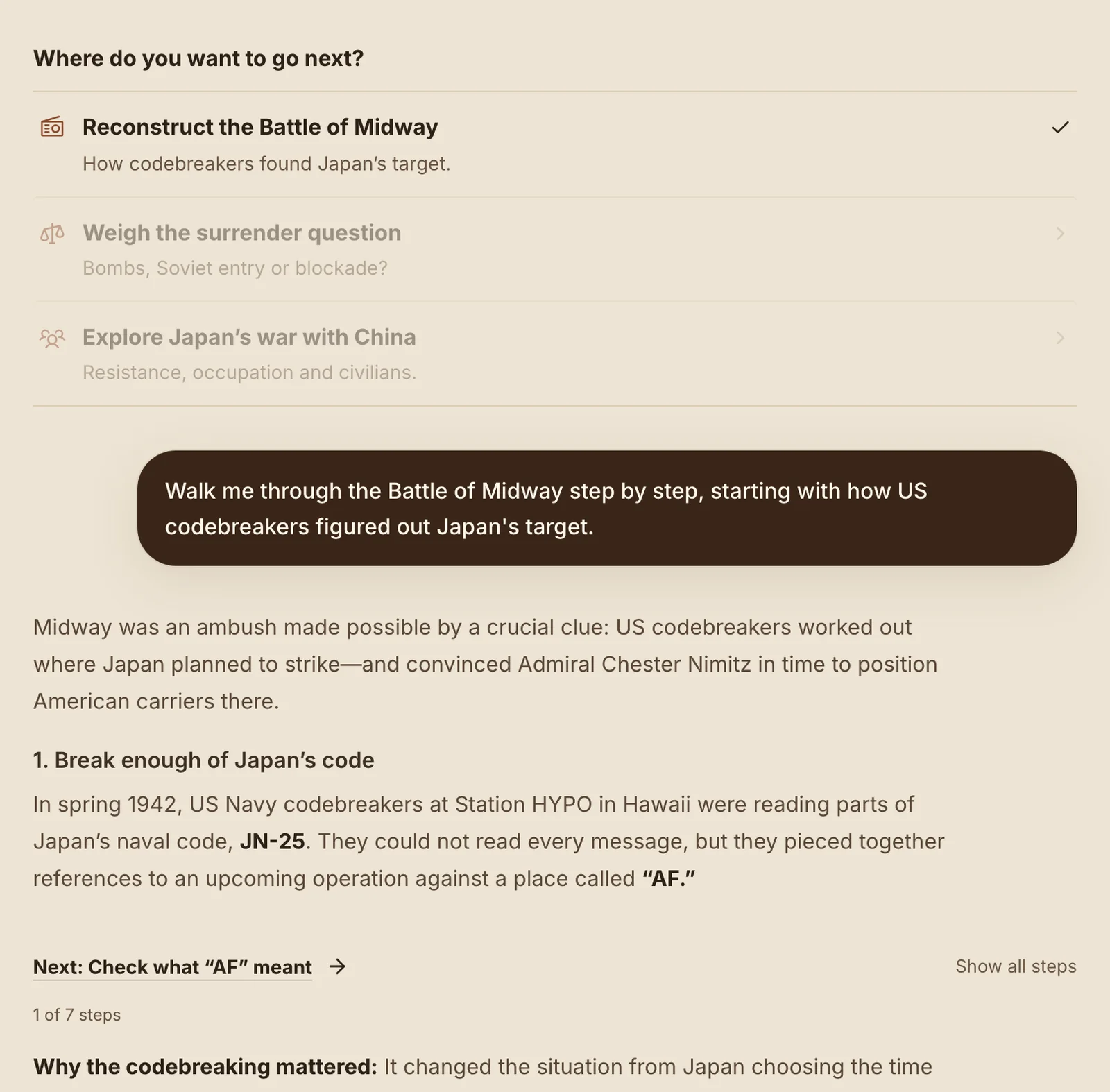
After a lesson on the Pacific War: two paths deeper (how Midway was won, what ended the war) and one adjacent (the war in China, which most students never connect to Pearl Harbor). The student chose Midway, and the next lesson begins. The lesson is a reference answer written by our team; the Midway lesson that follows was generated by the tutor.
The food web answer ends the same way: why there are so few predators and how predator and prey populations cycle, both deeper, and invasive species, adjacent. Each suggestion is phrased as something the student would want to know, not as a topic heading.
We think this matters well beyond education. Most of the value of a good teacher, or a good book, or a good friend who knows a subject, is in pointing at the next interesting question. An assistant that helps someone ask their next question can be worth more than one that perfectly answers their current one. The choice still belongs to the student. The tutor’s job is to make good choices visible.
The model is the author
None of these answers are templates. A Chalk answer is written by the model, in a compact language that interleaves ordinary prose with a closed vocabulary of about forty interactive pieces: steps, checks, sliders, graphs, charts, tabs, flows, scenes, sortable cards, hints, sources and next steps. The application compiles what the model writes, validates it, and renders it with real components. The model never writes arbitrary code, and nothing it writes runs unchecked.
That makes Chalk a medium for teaching decisions rather than a gallery of widgets. Every answer requires a chain of choices: what the student should try, which representation makes that attempt possible, where to pause, how much help to offer, and what to ask afterward. The pieces cannot make those choices. The model has to.
That is also why Chalk came after our first harness. A model that had to end every turn by filling in a fixed form left little room to compose, and we never got anything like Chalk working inside it. Chalk became possible once we rebuilt the tutor as an agent that works in a loop and simply writes its answer.
Teaching a model to author well is the hardest open problem in this work. Several examples in this piece are reference answers our team wrote by hand in Chalk, to define what excellent looks like. The tutor generates answers in the same medium, like the Midway lesson above, and closing the distance between its answers and those references is what we are working on now.
We have run many rounds of experiments on closing that gap. We tried telling the model to plan the composition before writing, giving it short contrasting examples of strong and weak answers, pruning its instructions, adding a separate planning stage, and letting it see a rendered image of its own draft before finishing. Nearly every idea produced impressive individual answers. Almost none of them produced a consistent improvement once we replicated them on fresh topics the changes had never seen. We now treat a single great sample as a hypothesis, not a result.
One lesson from those rounds changed how we evaluate everything. The model’s source being valid is not the same as the student seeing what the model meant.
In one experiment, a model drew two fractions out of filled and empty squares to compare them: ten of fifteen and nine of fifteen. Its source was accepted without errors. The version a student would have seen showed five of ten and six of nine, a different comparison, with all the labels intact. We found it by inspecting the rendered answer, not the source, and fixed the compiler step responsible.
The self-preview experiment produced a similar surprise. In one run, the model looked at a render of its draft, made a revision, and introduced a new overlap in a diagram in the process. Asked afterward, it did not remember making the edit. Both cases point the same way. For a medium like this, the only trustworthy evaluation looks at exactly what the student will see.
Keeping it cheap enough to be ordinary
Interactivity is only useful if it is normal, and it is only normal if it is affordable. A tutor that can build one lab per week is a demo. We wanted Chalk to be something a student could use on an ordinary Tuesday, several times, without anyone worrying about the bill. Cost shaped the architecture from the start.
The most important decision was dividing the work. The model’s job is the teaching: deciding what to build and interpreting what the student does with it. Everything after that runs in the browser. When a student drags a slider, reveals a step, sorts a card or answers a check, the update is computed locally from what the model already wrote. The model is not called again until the student actually says something new.
- Student asks; tutor builds the lesson
- Drags sliders
- Opens a hint
- Answers a check
- Picks a next step
- Reveals steps
- Tutor reuses a saved lab
- Explores it
- Model writes or responds
- Runs in the browser, no model call
- Existing activity brought back from the drawer
An illustrative session with twenty-six student actions. Three reach the model, and one of those is the tutor inserting an activity it already has instead of writing a new one. Everything else, every slider, step and check, costs nothing to serve.
The second decision was reuse. Common, well-built activities such as a pendulum lab, a unit circle or a projectile simulator live in a drawer the tutor can draw from. Instead of writing a full lab from scratch, the model writes a single line asking for the one it needs, with parameters for this student’s problem. The tutor spends its output on the teaching around the lab instead of rebuilding the lab, and the student gets an activity we have already tested.
The third was keeping the medium itself compact. Chalk’s initial authoring guide fits within 12,288 bytes, with detailed component documentation available on demand, so teaching the model the medium adds little to each request. Writing interactive content inline, as part of the answer, also turned out to be far cheaper than generating it as a separate structured object: in our tests, a median of 341 output tokens instead of 973, in half the time.
These choices compound. Authoring is cheap because the language is compact and drawers save rewriting. Interaction is free because the browser handles it. Returning to an activity costs a line. The point of all of it is the same: so each student’s budget buys more chances to think.
From answers to experiences
Using Chalk does not feel like reading a chat transcript. It feels closer to working through something with someone who prepared for you. We think that is where AI assistants are headed in general, and that it matters most in learning, where the goal was never the answer in the first place.
Others are heading the same way. Google’s Learn Your Way turns a textbook chapter into formats a student can choose between: interactive text with embedded questions and quizzes, slides, video, an audio lesson and a mind map. In an experiment with 60 students aged 15 to 18, those who used it scored higher than students who read the same chapter as a digital textbook, 77% against 68% on a test right after and 78% against 67% three to seven days later.11 It transforms a chapter once, while Chalk builds each answer inside a tutoring conversation, but it is controlled evidence that AI-built material students act on can beat the page they would otherwise read.
The research shows that what students do with an explanation affects what they learn. Our early testing pointed the same way. Chalk is our attempt to take that seriously in every answer: give the student something to predict, something to break, and somewhere to go next, and keep it cheap enough that they never have to ration it.
Methods and scope
Early-user findings come from qualitative testing with roughly twelve to fourteen people who tried different Chalk designs during development. They describe how people engaged with the designs, not measured learning gains, which we have not yet studied in a controlled way.
Examples in this article are captured from the product’s student interface, rendered locally from stored answers in a test account. Captions note whether each answer was generated by the tutor or written by our team as a reference. The cited studies support the principles discussed here; they are not a complete list of the research we drew on. The segmenting, pre-instruction and simulation studies tested those ideas in other settings, and the question-asking study documents the problem our suggested paths respond to. None tests Chalk itself, and the two-deeper-one-adjacent pattern comes from our own early testing. Productive-failure studies give students an extended problem to work on before instruction; Chalk’s predictions and sorts are far shorter, and whether they keep the benefit is untested. Learn Your Way was tested on a single chapter, and its students spent longer with the material than the textbook group did, about 31 minutes against 22. Tutor-generated Chalk answers do not yet reach the quality of the team-written references every time.
The inline-versus-artifact comparison used twelve hand-written K–12 prompts with up to three repetitions each on one model, with medians taken over successful runs. The session in Figure 7 is illustrative.
Updated November 11, 2026: narrowed the claim about young children after Sinha and Kapur’s meta-analysis of productive failure, and added Google’s Learn Your Way study.
Footnotes
-
Michelene T. H. Chi and Ruth Wylie, “The ICAP Framework: Linking Cognitive Engagement to Active Learning Outcomes”, Educational Psychologist, 2014. ↩
-
Richard E. Mayer and Paul Chandler, “When Learning Is Just a Click Away: Does Simple User Interaction Foster Deeper Understanding of Multimedia Messages?”, Journal of Educational Psychology, 2001. ↩
-
Henry L. Roediger III and Jeffrey D. Karpicke, “Test-Enhanced Learning: Taking Memory Tests Improves Long-Term Retention”, Psychological Science, 2006. ↩
-
Lindsey E. Richland, Nate Kornell and Liche Sean Kao, “The Pretesting Effect: Do Unsuccessful Retrieval Attempts Enhance Learning?”, Journal of Experimental Psychology: Applied, 2009. ↩
-
Manu Kapur, Productive Failure: Unlocking Deeper Learning Through the Science of Failing, Jossey-Bass, 2024. ↩
-
Tanmay Sinha and Manu Kapur, “When Problem Solving Followed by Instruction Works: Evidence for Productive Failure”, Review of Educational Research, 2021. Across 166 comparisons, the overall effect was Hedges’ g = 0.36. ↩
-
Marci S. DeCaro and Bethany Rittle-Johnson, “Exploring Mathematics Problems Prepares Children to Learn from Instruction”, Journal of Experimental Child Psychology, 2012. ↩
-
Shannon F. Harp and Richard E. Mayer, “How Seductive Details Do Their Damage: A Theory of Cognitive Interest in Science Learning”, Journal of Educational Psychology, 1998. ↩
-
N. D. Finkelstein et al., “When Learning About the Real World Is Better Done Virtually: A Study of Substituting Computer Simulations for Laboratory Equipment”, Physical Review Special Topics - Physics Education Research, 2005. ↩
-
Arthur C. Graesser and Natalie K. Person, “Question Asking During Tutoring”, American Educational Research Journal, 1994. ↩
-
Courtney Heldreth et al., “An Experimental Evaluation of an AI-Powered Interactive Learning Platform”, Frontiers in Artificial Intelligence, 2026. ↩
Cite this
Trevor Rosato. "Handing students the chalk." research.honorlyai.com, October 27, 2026. https://research.honorlyai.com/handing-students-the-chalk/
BibTeX
@misc{honorly_handing_students_the_chalk_2026,
  author = {Rosato, Trevor},
  title = {Handing students the chalk},
  year = {2026},
  howpublished = {\url{https://research.honorlyai.com/handing-students-the-chalk/}}
}